Showing posts with label garden. Show all posts
Showing posts with label garden. Show all posts
Tuesday, February 9, 2010
Chester Nimitz Oriental Gardens
Upon first hearing this song years ago on KFJC I knew that some day I would sip tea across from these gardens.
Sunday, January 27, 2008
Frog in the House
 When we came home from session tonight Sharon discovered a frog on the landing leading down to the garage. I was surprised that Marilyn didn't attack and eat it.
After taking a picture I put it out back under the oak. That is where we have been hearing the frogs singing of late.
Sunday, September 2, 2007
Garden Lighting
Dave came by with the draft of the landscape design. I've started thinking about power and lighting.
Just found this Outdoor lighting supplies site, brouse it to see what is available.
Here are our notes from the Landscape Design Class.
- Low voltage, not solar
- defused glass, reduce glare
- sconces illuminate without getting in your eyes
- well lights or up lights
- high quality equipment, Home Depot crap will need replacing is a couple of years
- plan early, install after plants
- low voltage wires run under mulch
- uplighting the oak outside the master bedroom.
- moonlight patio from oak
- accent light on water feature
- illumine the steps next to the drive way
- massive shadow out of front planters up side of garage
- Japanese maple shadow under parlor window
- uplights along pateo rock wall to highlight stones and grasses
Monday, August 6, 2007
Beautiful Ikebana site
Daniel Ost has a great Ikebana style. Check out his stuff.
 I don't know what "style" or Ryu he is from, but my guess is his ego is to large to fit into one. None the less, his eye is wonderful.

 I don't know what "style" or Ryu he is from, but my guess is his ego is to large to fit into one. None the less, his eye is wonderful.

Wednesday, July 25, 2007
Pavers for the patio
Did some research into materials for the deck in back. There are a lot of options, most are easily ruled out.
Potential materials are:
- AstroLawn®
- Brick
- Cobble stone
- Cobble Systems
- Concrete
- Dirt, packed
- Flagstone
- Grass
- Gravel
- Pavers
- Stamped concrete
- Wood
We are going to go with pavers for these reasons:
- Low maintenance
- Professional installation, I don't have time/back to do myself
- Select color we want
- Interesting patten to give the space flow
- Flexible dimensions, go around curved wall and water feature
- Do it yourself repair
- Long life, does not weather
- Fire proof
- Earthquake resistant, repairable
- Not tracked into the house
- Not outrageously expensive
I wonder what the cost of running pavers around the house to the drive would be? [Est. 120 linear feet, 3 feet wide, $10-15 per square foot plus stuff comes to about $4ooo-$6000.] It might be a secondary project for another year.
Resources
Pacific Outdoor Living, good informational site that explains why you want pavers with professional installation.
A & A Stepping Stone, our local manufacture of pavers, just down the street.
Local library for books on patios, decks and gardens.
Paver estimator widget to figure out what your project is going to need in the way of materials.
Basalite calculator widget is another place to look. Very good specs of different vendors.
Glossary of paver terms.
Wednesday, July 18, 2007
Lot Size
 The house in on lot #11 of the Woodland Estates development. This bit of map is from the Placer County assessor's office. The building square footage is 2793 and the garage square footage is 808.
The curb is 63 and the back fence is 84 feet long.
Here are the dimensions of the house (a different scale than above). Note that the 2 Car Garage is under the house proper so the measurements of the house are all you need. [Click on the image to get a better view.]

Tuesday, July 17, 2007
Rain Gutters
 The wild fire mitigation tips say that we should keep the roof and gutters free of debris. I looked into the Rain Helmet type protection systems and they cost $10 to $20.00 per foot installed. We have the k-style gutter pictured.
I don't have that kind of money to spend plus you still need to do maintenance to clear the debris off the roof and clogged gutter protectors. No thanks. I took the money and bought a Little Giant ladder big enough to reach the second story roof. I'll clean them out myself Gates DOS it!
I read a lot about this back in December when we made the decision not to do the fancy solution. There was one place back east that had an interesting design that seamed to be to be very good. All I remember is that I didn't find any negative reviews (but found plenty of negative reviews of the fancy solutions). I'm going to see if I can find that site again and order three inside corners from them. The rest of the gutter I'll going to use the le cheapo Home Depot plastic do-it-yourself covers, $1-2 per foot.
Incidental, it was during the aforementioned research that I came across the idea of taking the money you would have spent to install the ritzy gutter system, invest it in a CD then use the interest to hire a guy to clean the gutters for you when they need it.
eGutter is a place to buy gutter supplies.
What about using rain chains? Perhaps running a hose up into the oak and having rain chain fountain(s) into the suikinkutsu. Ummmh, tinkly.
Eleven things to ask about a gutter protection system.
The Waterloov® leaf guard system could be the one I liked last year.
Wildfire Mitigation
As we develop our landscape plans we want to keep wildfire mitigation in mind.
It is very important to realize that no (livable!) house is fire proof, but you can make it more fire-safe!
Things we could do today:
- Remove leaf and branch debris from roof
- Clean out gutters
- Hoses on all spigots
- Cut back the rest of the "dead" grass in the back
- Remove the small trees under the oak, fire ladder into canopy
Resources
- Firewise Communities, part of the National Wildland/Urban Interface Fire Program.
- Howeowner's Wildfire Mitigation Guide, by UC Berkeley.
- Quick Fixes
- Wildfire Mitigation Resources, by Colorado State.
- National Wildfire Programs Database
Sunday, July 15, 2007
Phase II begins
Dave of LandShaping came by yesterday to start the planning process for Phase II of your garden. This blog details many of the things we talked about.
Fire Mitigation
Plants should be in clumps, burn by them selves, not is stretches that will fuel a path for a wild fire. Visualize a fire ladder when planting next to the house, not good.
Put a garden hose at each spigot. When a fire starts the time to bring the hose around from the other side of the house is critical.
AI 4 jaya- talk to the local fire house. Ask them what we can do. Ask them if there is a way to mark the house so that in case of an emergency they will see that we have a high volume hose for them to utilize.
Weed Control
We will be putting down weed fabric to minimize the growth of unplanted plants.
Poison Oak
I had hoped that Dave would see our poison oak and say "poison oak, I can get rid of that for you." Instead he told us that we should work on getting rid of it and that it may take years to totally eradicate. All the usual warning. He also noticed that the trash shrubbery on the east end of the back fence is a "poison oak tree".
I'm going to start removal after band camp. Should I get some poisoning I don't want to have it on my vacation.
I'll need the large red bio-hazard bags from work, disposable gloves and some Brush-B-Gon . I found Ortho® Brush-B-Gon® Poison Ivy Killer, I think this will do the trick.
Patio
We are looking at almost 400 square foot of pavers. Dave suggested we stain the existing concrete pad to match the pavers (less expensive then removal or covering with thin pavers that will show the transition between the types of pavers. We will be using A & A Stepping Stone, just down the road. They have a good website for discovering the possibilities.
Steps and Path
Dave mentioned Three Rivers Wall Stone for consideration out front. We decided NOT to use crushed/decomposed granite as it will get tracked in and damage the floors.
LandShaping
Dave Polgar from came by yesterday to listen to your ideas for landscaping the house. We sent an hour going over our ideas, answering questions and asking us questions to clarify his understanding of what we want.
The LandShaping website has some pictures of Dave's work. He lives here and Auburn and may be contacted at 530-383-0798.
We're looking forward to working with Dave again. He helped us out when we first got the house with the erosion control measures.
The following entry details Dave's visit.
Sunday, July 8, 2007
Paving Ideas
We are ready to start planning the hardscape for the house. The water feature ideas we have are listed another blog entry this one will cover paving ideas.
A feature of the house and land is the red clay and stone. We want to use this and not fight it. We love the way the rock wall flows and blends into the land.
The back porch is concrete and looks like a condo patio. We are going to extend this patio out toward the rock wall, leaving planting space. It will go just a couple of feet toward the master bedroom window and swing around to the left toward the office window. I think it would be nice if the patio material came all the way up to the back door, covering the cement pad.
Walk beside driveway
The driveway is to steep for old people to walk up without injuring their Achilles tendons. Sharon thinks a walkway straight up the hill on the left of the drive, with steps as needed, will make the house more inviting. Again, we like the stone found on the property and will use it to make the "informal" steps up the hill.
Walkway to the back
From the top left of the driveway, running in front of the cement steps, we are going to put a path that goes around to the back of the house, past the kitchen and office. I am thinking crushed granite (this is what we used at the SF Children's Zoo, it is great and easy to repair). But I am open to suggestions. The requirements for this path are; wheelchair accessible, erosion resistant, comfortable to walk with "bad knees", keep shoes clean when it is raining and make the house more inviting.
Water spigots
In front of all the outdoor water taps we want a clean non-muddy place to stand. Perhaps the walk material could be used to pave the spigots. To prevent the force of the water from eroding indigenous stone will also be used. The one to the right of the garage could be a cement pad, extended driveway surface. What about putting the trash and green waste cans outside on this pad. Will we need to hide the cans from the street?
Stone facing
There is a product for covering flat walls with stone that goes up like siding. There is a flavor that roughly matches the stone on site. That might look good covering the cement facing the street use in the front steps and giant planter boxes.
Sidewalk stone wall
When I first saw the house I though a knee high stone work wall look nice along the sidewalk. It would draw the eyes down, complement the stone work around the house and give us a level planting area for flowers and such. However, after living here and seeing similar stone walls around the neighborhood I'm thinking it might not be such a good idea 5 to 10 years from now, the earth moves. In any case, Sharon did this great mockup of what it could look like planted with manzanita (see March 2nd blog).
Water Feature Ideas
We are ready to start planning the hardscape for the house. The water feature ideas we have are listed in this entry, another blog entry will cover paving.
We want a water feature that will generate a little bit of cooling water sound. Not a loud fountain but something more subtle and meditative. We are thinking that it will go against the wall either outside the office window or in the inside corner (see picture). 
Personally I think a suikinkutsu would be audiosome. And I have always wanted a shishi odoshi in my garden (see photo). I am concerned that the clacking may get annoying in time and bother the neighbors. Perhaps I should install a pin to keep it from dropping and just allow the water to fall into the basin via the bamboo water vestal. 
Or maybe just a simple pot with water shooting straight up and falling back in, variable speed motor to control the height/volume. We saw a beautiful ceramic at the spa store today, royal blue carp jumping with its mouth open (two feet tall).
In any case we need to decide upon the location and run the plumbing. I want it to automatically fill and it will use an electric motor so we need to run a water pipe and electricity to the location. If there are no low voltage fountain pumps then we will install an electric outlet that may also be used to plug in radios, bug zappers and such.
In a few years we will install a covered hot tub, just outside the master bedroom window. This will need plumbing, electrical and a cement pad. I don't expect this to impact the landscaping as we have access under the house to this area.
Monday, May 28, 2007
First Zucchini
Our first zuchinni fruit was on the vine today. About four inches long, we'll eat it next time we cook vegatables.
It was planted on March 25.
Thursday, April 26, 2007
Cremation and global warming
Sharon and I listened to a Scientific American podcast this morning that started us thinking about the impact of our deaths on the environment.
The cremation of the average male in Australia (less fat then the American male), during which the body is heated to 850 degrees Celsius (1,562°F ) for 90 minutes, produced more than 110 pounds of carbon dioxide. Hey, selling the carbon credit for your cremation could return enough cash for a proper plant me in the earth burial.
We decided that the suggestion to drill a hole in the ground and stick the "natural" body in feet first with a tree sapling as a marker is the way to go. This should take place with the leftover parts after the "donation my body to science" people are done.
Setting up a company to help people compost their loved ones may be a nice business opportunity for aging baby boomers. There will be some zoning and health code reform required before it is commercially viable but you might be able to get away with it in your own back yard if the neighbors don't complain (just like we to today with the kid's dead pets).
Check out the Yahoo!News article, Scientist says cremation should meet a timely death, on the subject.
Sunday, March 25, 2007
Tomato Plants in the ground


 Sharon and I planted our first garden vegetables this afternoon, March 25, 2007.
Left to right, tomato 'Ace', Zucchini squash (Verdura Calabacin), and Better Boy tomato.
May 10; Better Boy tomato flowered a week or so ago. The Ace tomato has not yet flowered. Zucchini, who cares, I started growing straight away and had flowers after several days.May 28; first zucchini, 4 inches. We ate it and it seemed better than store bought.
June 9; we noticed the first tomatos on the Better Boy. There is another zucchini as well.


Saturday, March 10, 2007
Boulders for the Yard
On our weekend walk Sharon and I saw two rocks that are just the ticket for our landscape plans.


The first boulder we spotted was perfect. It looks like it was thrown high in the air and burried deep into the ground on impact.


I think we liked this second boulder because of all of the moss. This one was spotted on the Flood Road Trail.


Do you see the baby elephant?
Friday, March 2, 2007
Stone wall with Manzanita
We have been talking about using the rocks on the property to build a short wall along the sidewalk. My idea was to have a flat place to grow vegetables, herbs and flowers that thrive in baking summer sun.

Some of the places we go for walks have Manzanita trees so we got to thinking about using them in the front. They can be pruned to emphasize the clean bark and line of the tree. I like the skeleton nature of the plant in winter; it would look great under up lighting.

The picture below shows the manzanita in a more natural setting. If we use it out front we will prune it to accentuate the wood, not so much foliage.
Sunday, February 25, 2007
Water Feature Side Effect
The soil was scraped away before the foundation was laid. What was left is the clay subsoil.
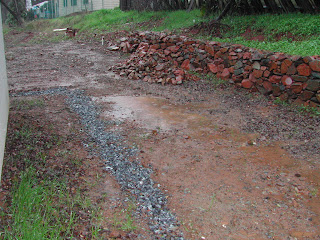 You can see were Dave put a drain from the downspout outside the office. Clearly more needs to be done to allow the water to move into it.
When we get a bit of rain the low spots in the property become self evident from the poorly percolating soil resulting in puddles that last for days.
 You can see were Dave put a drain from the downspout outside the office. Clearly more needs to be done to allow the water to move into it.
 We were thinking a drain running the length of the house that connects up the two down spouts wouldn't be a bad idea.
 We'll need to catch all this water and move it into the drainage system so that it doesn't erode along the fence line.
 The erosion control installed in the front of the house is working out quite well. Hardly any soil is on the sidewalk now. Click on the image above to see the erosion in the earth next door. The three pop ups seem to be working just fine.
Saturday, February 24, 2007
Saturday, February 17, 2007
Oak Tree―Woodland Habitat
We have this grand oak tree in the back (click on picture below). I've been doing research to identify our responsibility and have written some of it down here. The landscape design class instructors said that to much water would injure an oak tree but I want to know more about oaks before I took action.
 The are twenty species (30 varieties) of oak in California ranging from the coast through the central valley and into the Sierra Nevada. The Indians used the acorn as a primary food source and the white man used its wood for building and fire. It wasn't until recently that the oak as been valued/recognized for their ecological, economic, scientific, and aesthetic value. Like the rocks in the great Sierra Nevada Range these noble trees were taken for grant by the immigrants; perhaps because they are so plentiful or because there are similar to the trees of their native lands.
 The are twenty species (30 varieties) of oak in California ranging from the coast through the central valley and into the Sierra Nevada. The Indians used the acorn as a primary food source and the white man used its wood for building and fire. It wasn't until recently that the oak as been valued/recognized for their ecological, economic, scientific, and aesthetic value. Like the rocks in the great Sierra Nevada Range these noble trees were taken for grant by the immigrants; perhaps because they are so plentiful or because there are similar to the trees of their native lands.
The library has a nice book called Oaks of California
The California tree oaks have a great deal of diversity. They adapt to micro climates well changing leaf morphology, photosynthesis capability, drought resistance strategies, size and structure (limb configuration). These are not genetic traits that are passed on through acorns but environmental adaptations. This variability makes taxonomic classification difficult with out taking the environment into account.
The neighbors have a large oak that occupies the southeast corner of our house.
In walking the neighborhood I noticed that some of the oak trees have lost their leaves and some have not. The blue oak is a drought-deciduous tree, meaning that it looses its leaves by late summer when there are drought conditions. The trees that still have their leaves are invariably in the middle of rich green well watered lawns. Remember the comment from the Landscape Design Class instructors (top of this blog entry), I guess we will know for sure if we are over watering by the blueish-green foliage next Christmas.
The following photograph illustrates how the neighborhood got its name, The Woodlands; the name of the development project in which we live. Turns out it is both accurate and apropos of the landscape. Note that the tree that lives on the green lawn has it's leaves.

I believe we have a blue oak (Quercus douglasii) based on the key to the tree oaks of California published in the afore mentioned book.
Here is a satellite photo of the area taken before the road was cut and the trees cleared.

Blue Oak Habitat
The habitat traits of the blue oak that are applicable to Auburn are; found in the foothills bordering hot interior valleys, annual rain fall between 15-35 inches, soil not well developed, and below 3,500 feet in elevation.Blue Oak Distribution
The blue oak is found only in California where it is widely distribute to 39 of the 58 counties. It is the landmark species of the foothills in the Sierra Nevada range. Disjunct populations occur on the Sutter Buttes in the middle of the Sacramento Valley.
Field Trips
- US Davis Arburitium (oak tree collection)
- Indian Grinding Rock State Historical Park (Miwok Indians) acorn usage
Associated Hardwoods and Conifers
- madrone
- bay laurel
- incense cedar
- Douglas fir
- ponderosa pine
- gray pine
Glossary
- Overstory―The uppermost layer of foliage and branches in a piece of vegetation; the highest canopy.
- Savanna―A grassland with scattered trees as a sparse overstory. The tree canopies do not cover more than 30% of the ground surface.
- Snags―Trees that are dead but standing.
- Woodland―An open, tree-dominated vegetation with more tree cover than a savanna but less than a forest. Tree canopies contribute more than 30% cover but seldom overlap.
Subscribe to:
Posts (Atom)
